30th Academy Awards · 1958
The Bridge on the River Kwai
Directed byCooked up by David Lean
“It spans a whole new world of entertainment!”
“He understood the assignment a little too well 🌉”
The storyThe lore 📖
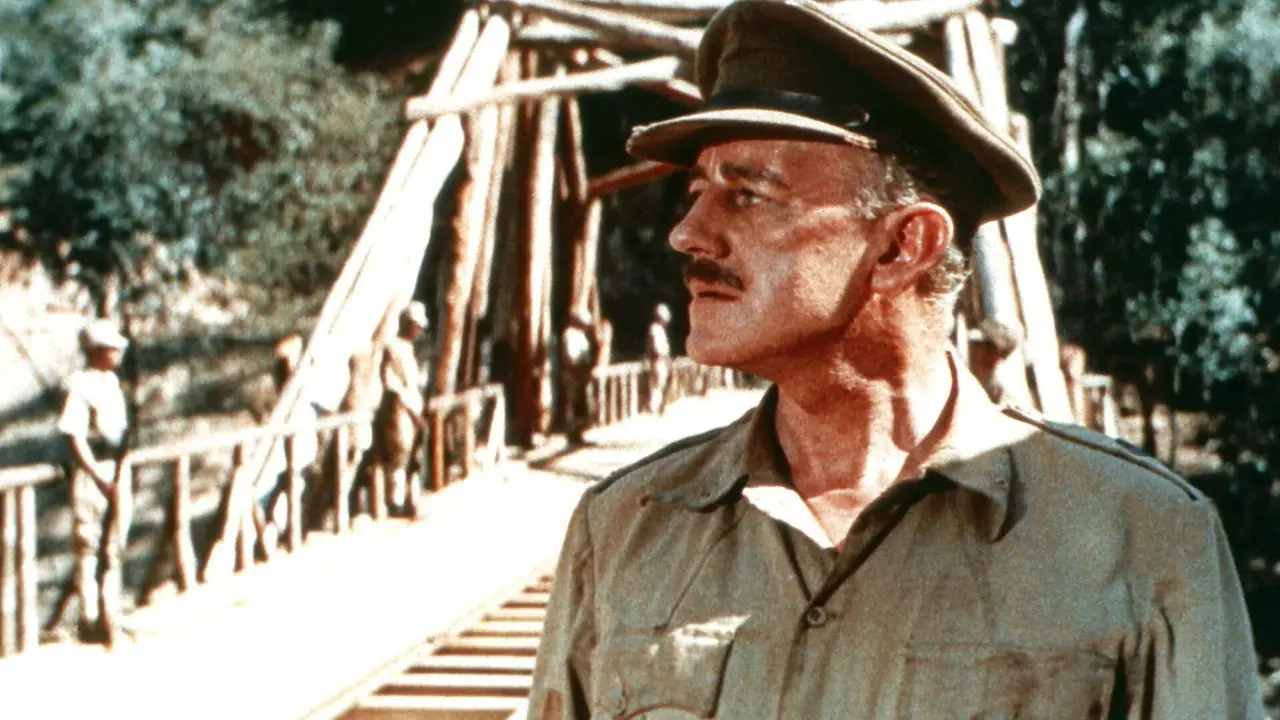
The classic story of English POWs in Burma forced to build a bridge to aid the war effort of their Japanese captors. British and American intelligence officers conspire to blow up the structure, but Col. Nicholson, the commander who supervised the bridge's construction, has acquired a sense of pride in his creation and tries to foil their plans.
During World War II, British prisoners in a Burmese jungle camp are forced to build a railway bridge for their Japanese captors. Colonel Nicholson gets so committed to building the best bridge ever that he lowkey forgets whose side it helps. Meanwhile, Allied soldiers are trekking in to blow it up. A serious movie about pride and the madness of war 🌉.
What critics & audiences sayThe receipts 🧾
 Tomatometer
96%
Fresh
#17 of 98 winners
Famous linesLines living rent free
What have I done?
…Let me remind you of General Yamashita's motto: be happy in your work. Dismissed!
You and that Colonel Nicholson, you're two of a kind. Crazy with courage. For what? How to die like a gentleman. How to die by the rules when the only important thing is how to live like a human being.
I hate the British! You are defeated, but you have no shame. You are stubborn, but have no pride. You endure, but you have no courage. I hate the British!
…there is no barbed wire, no stockade, no watch tower. They are not necessary. We are an island in the jungle. Escape is impossible. You would die.
Saito: I'll have to kill myself. What would you do if you were me?
Nicholson: I suppose if I were you, I'd have to kill myself. Cheers!
Must we work so well? Must we build them a better bridge than they could have built for themselves?
…the people that use this bridge in years to come will remember how it was built and who built it. Not a gang of slaves, but soldiers, British soldiers, Clipton, even in captivity.
You speak to me of code? What code?! The Coward's Code! What do you know of the Soldier's Code? Of Bushido? Nothing! You are unworthy of command!
…here in the wilderness, you have turned defeat into victory. I congratulate you. Well done.
Quotes via Wikiquote
Filming locationsWhere they shot it 📍
-
Kitulgala
Sri Lanka
The film's bridge was built near this town and blown up on camera in front of Ceylon's prime minister after a botched first attempt.
-
Mount Lavinia Hotel
Mount Lavinia, Sri Lanka
The colonial seaside hotel served as the location for the film's hospital scenes.
Fun factsFacts that go hard 🤓
- Blacklisted screenwriters Carl Foreman and Michael Wilson wrote the script in secret, so the Oscar went to novelist Pierre Boulle, who did not speak English; the Academy only awarded Foreman and Wilson in 1984, posthumously.Wikipedia · Screenplay
- The first bridge explosion was ruined in front of Ceylon's Prime Minister when a cameraman couldn't get clear in time; the train crashed into a generator, was repaired overnight, and blown up the next morning.Wikipedia · Filming
- According to a former POW, the whistled 'Colonel Bogey March' was born when David Lean yelled at extras who couldn't march in time to 'whistle a march to keep time to,' and an expert whistler started up.Wikipedia · Music and soundtrack
- Alec Guinness said he based Colonel Nicholson's walk out of 'the Oven' on that of his eleven-year-old son, who was recovering from polio, and called it the finest piece of work he had ever done.Wikipedia · Filming
- Thanks to the film, the real Mae Klong river in Thailand was renamed Khwae Yai in the 1960s; Pierre Boulle had never visited the bridge and wrongly assumed it crossed the Kwae.Wikipedia · Historical accuracy
- Cary Grant was offered the role of Colonel Nicholson but turned it down, and Charles Laughton was reportedly David Lean's first choice, though Lean later denied it.Wikipedia · Casting
- David Lean and Alec Guinness clashed constantly; Lean wanted Nicholson played as 'a bore' and once told the English cast to go home, thanking God he would be working with American William Holden the next day.Wikipedia · Filming
- Composer Malcolm Arnold had ten days to write about forty-five minutes of music and called it the 'worst job I ever had in my life,' yet it won him an Oscar and a Grammy.Wikipedia · Music and soundtrack
- William Holden's deal for 10% of the film's gross receipts was considered one of the best ever for an actor at the time.Wikipedia · Casting
- ABC paid a record $1.8 million for TV rights, and the uncut 1966 broadcast drew a record audience of 72 million viewers.Wikipedia · First TV broadcast